 |
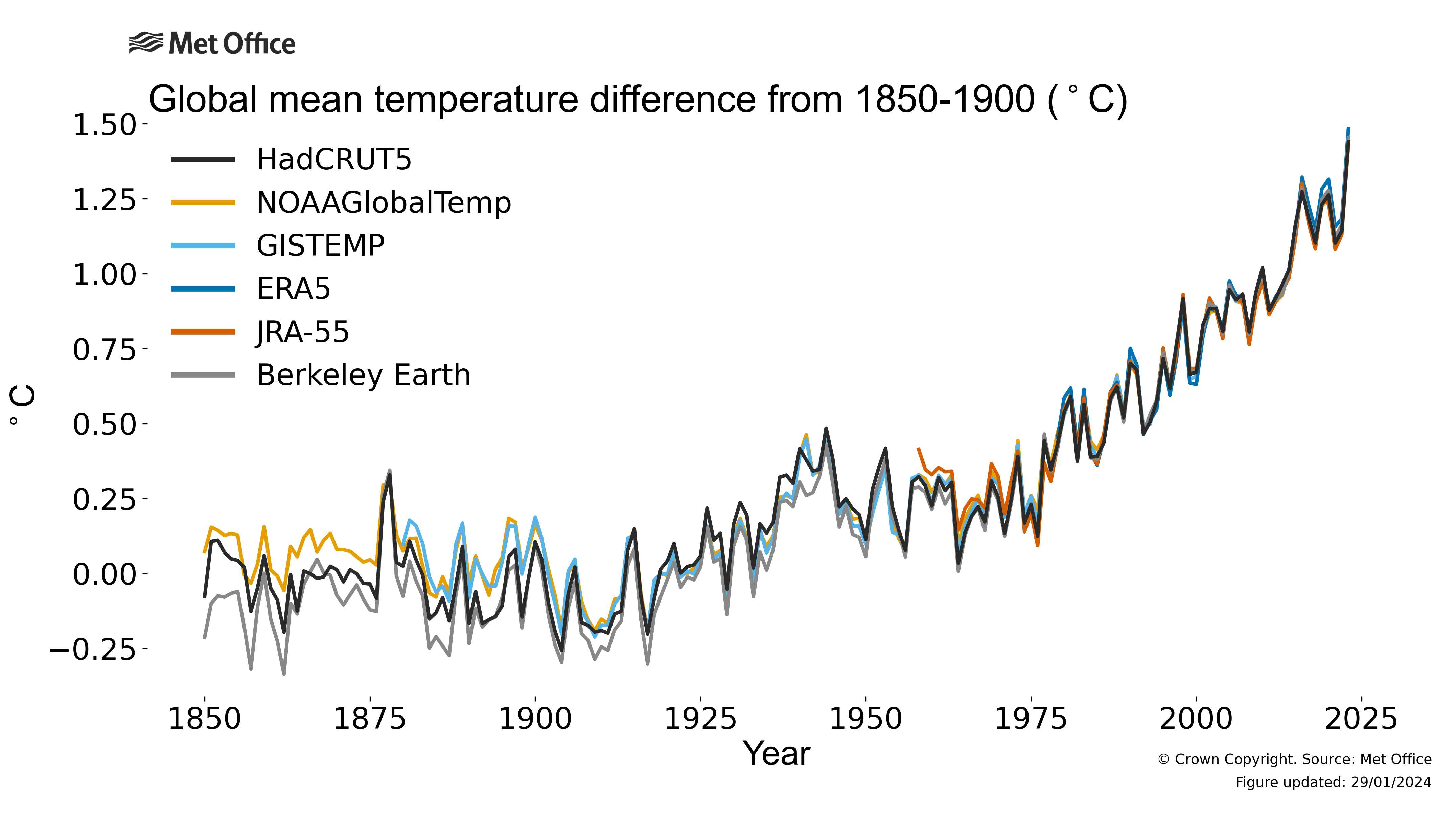
| Recent Acceleration of Global Temperatures (1850 - |
The brief interlude presented in the previous post focused on the just released Doomsday Clock.
Now let's get back to the discussion concerning atmospheric gasses.
But first let me point out that we have been perusing the Lundstad et al. datasets,which do not include the record setting high global temperatures of recent years because they made their report circa 2020, and soon after that the warmest year on record took place in 2024 (see graph above).
Take a look at the dynamics of the atmospheric gases to get a grasp of trends in globally-averaged CH4, N2O, and SF6 determined from NOAA Global Monitoring Laboratory measurements. Version 2026-01.
That pattern fits with the global temperature pattern of recent origin (see graphs below).
So, let's continue with recent concepts.
What are aerosols?
The trace gases such as water vapor can take up as much as 4% of the atmosphere, and that impacts aerosol content:
"Aerosols are small particles suspended in the atmosphere. They are often not or barely visible to the human eye, yet their impact on climate, weather, health, and ecology are significant. This page introduces the various major types of aerosols, and explains why researching them is important. Aerosols range in size from a few tens of nanometers—less than the width of the smallest viruses—to several tens of micrometers—about the diameter of human hair. The size and composition of aerosol particles affects how far they can travel around the world, their interactions with solar and thermal radiation, and their potential effects on health. Aerosols injected into the atmosphere directly are known as 'primary aerosols'. Sea spray, mineral dust, smoke, and volcanic ash are all primary aerosols. Secondary aerosols are aerosols which were emitted in another form (e.g. gases), then become aerosol particles after going through chemical reactions in the atmosphere, such as sulfate aerosols from volcanoes or industrial emissions. All aerosols can also undergo further chemical changes, referred to as ‘aging effects’. Some more information about these various aerosol types is given below."
(NASA; cf. Wikipedia Aerosol, here, and here).
The next post in this series is here, the previous post in this series concerning atmospheric gasses is here.
 |
| Methane |
 |
| Carbon Dioxide |
 |
| Nitrous Oxide |
 |
| Sulfur Hexafluoride |


No comments:
Post a Comment