If you watch politicians and media folk use their bag of on-camera gestures, one that is quite popular now is what I call the "square-finger" gesture.
It is common to all political party members and TV channel media members.
When I first noticed the wide array of spontaneous uses, I began to count how many times a day over the past year it was used during an interviewee's response/explanation to an interviewer's question.
The square-finger gesture is used to "help explain" subject matter of many types.
It does not seem to matter which pundit, what time of day, what type of TV news or talk show, what subject matter you are viewing, or whether the square-finger gesture is used to man-splain or woman-splain what the splainer is 'splainin'.
The insurrection was this big
No, the square-finger gesture is ubiquitous and shows up spontaneously.
After going through the mini-shock of even noticing the phenomenon in the first place, then seeking to make sense of it by attempting to count how many times a day it occurs, I next tried to make more sense of the square-finger gesture by determining the context in which the square-finger gesture was used.
I haven't finished that research, but at the moment it seems to be used when the 'splainer has some degree of fear attached to the subject matter being 'splained.
and ...
That is, it is used to minimize some aspect of the subject matter at hand by indicating "this subject matter is only this big, so I am in control of it" a la "Comparing a Group-Mind Trance to a Cultural Amygdala".
I have not yet finished my research on this, so help me out on this one by informing me and fellow Dredd Blog readers if you too have noticed the square-finger gesture (and don't forget to keep sending in your annual helpful responses to "My First Science Fiction Novel").
and ...
While doing so, remember that football is played on both sides of the ball (How to control the TV with gestures).
The phenomenon has not made it to one particular online site yet:
and ...
"Gestures are a form of nonverbal communication in which visible bodily actions are used to communicate important messages, either in place of speech or together and in parallel with spoken words. Gestures include movement of the hands, face, or other parts of the body. Physical non-verbal communication such as purely expressive displays, proxemics, or displays of joint
and ...
attention differ from gestures, which communicate specific messages. Gestures are culture-specific and can convey very different meanings in different social or cultural settings. Gesture is distinct from sign language. Although some gestures, such as the ubiquitous act of pointing, differ little from one place to another, most gestures do not have invariable or
and ...
universal meanings but connote specific meanings in particular cultures. A single emblematic gesture can have very different significance in different cultural contexts, ranging from complimentary to highly offensive. This list includes links to pages that discuss particular gestures, as well as short descriptions of some gestures that do not have their own page. Not
and ...
included are the specialized gestures, calls, and signals used by referees and umpires in various organized sports. Police officers also make gestures when directing traffic. Mime is an art form in which the performer utilizes gestures to convey a story.Charades is a game of gestures."
And let's not forget that any form of communication can be truthful or false, but gestures are probably a situation where proving someone was not "telling" the truth would be much more difficult to prove.
... and ...
How could we tell if they were saying "taxes will only be this much" or "I was this close to winning" or "I was only going this fast officer"?
More only this much research is needed to know for sure.
This morning, according to presidential historian Jon Meacham, speaking on Morning Joe:
On xMass eve in 1929 president Hoover was heading up a White House Dinner of elites.
During that celebration fire alarms went off as the Oval Office in the West Wing caught fire.
The President, smoking a cigar, watched the firefight as it burned.
The First Lady wanted the band to continue playing xMass music.
(Paraphrased, see also this). It reminded me of the movie "Titanic" where the ship of that state was going down but the band kept playing.
Like the days daze just prior to the "Great Depression" when a popular economist Irving Fisher gave an "everything is ok, don't worry, be happy, the stock market and economy are the best ever" type of speech:
"The stock market crash of 1929 and the subsequent Great Depression cost Fisher much of his personal wealth and academic reputation. He famously predicted, nine days before the crash, that stock prices had 'reached what looks like a permanently high plateau.' "
The doomsday clock, like the drumming rabbit, keeps on ticking closer to midnight (Doomsday Clock).
In an "unrelated" crescendo the Ring of Fire is also acting up (Fig. 1).
Whether these are fateful, existential eventualities, or simply coincidences, they converge in an area where most of the melt water from Greenland and Antarctica is ending up (The Ghost-Water Constant, 2, 3, 4, 5, 6, 7, 8, 9).
That added volume and weight of water is bending and deforming the crust of the Earth (Ocean Bottom Deforming).
And all of this is happening at a time when denial-ism is at an apex (A few minutes ago on MTP Daily, Chuck Todd argued that we should lose the Doomsday Clock).
There is also something profoundly wrong with the United States of America’s system of government, which is in among other things, in retrogression (American democracy is failing).
One has to wonder why people don't get the fact that we cannot go backwards in time by twisting the knobs on our wrist watch (Convergence - Fear of Death Syndrome).
Not even if we know that the past was better than the future is going to be (Where Have We Been?).
The next post in this series is here, the previous post in this series is here.
Tangled up in News ...
"... Gentlemen, he said
I don’t need your organization,
I’ve shined your shoes
I’ve moved your mountains
and marked your cards
But Eden is burning,
either brace yourself for elimination
Or else your hearts must have
the courage
for the changing of the guards ..."
"Twenty years of schoolin' and the put you on the day shift ..." - Bob Dylan:
Established in 1933, the Permanent Service for Mean Sea Level (PSMSL) has been responsible for the collection, publication, analysis and interpretation of sea level data from the global network of tide gauges. It is based in Liverpool at the National Oceanography Centre (NOC), which is a component of the UK Natural Environment Research Council (NERC).
(About PSMSL). That download is only the beginning of it, not the end of it, because then comes the software design and coding to handle it.
III. New Programs
Next I wrote C++ programs that parsed all of that flat-file structure-format data, so as to automatically put it into an SQL database (mySQL) as per usual.
I named the database "PSMSL" in honor of the hosts of the data.
Currently, there are three tables, "rlrdata", "stations", and "test".
The "stations" table has all the relevant tide-gauge data from around the world.
There are 1,417 tide-gauge station descriptions from around the globe.
Two of the columns or fields in the stations table are "latitude" and "longitude."
Those two allow the software to 1) identify each station as being within a zone, and 2) identify an ice sheet source as an impactor on that zone.
Thus, when relevant SLC (whether SLF or SLR) takes place in that zone, I can look to the source ice sheet to find out if there were visible dynamics such as calving (The Evolution of Models - 12) or melt.
The GRACE satellite detects either one of those phenomena, because loss of ice to melt or to calving means loss of gravity where the loss took place.
IV. SLC Fingerprint Zones
As you can see in Fig. 1, there are various coastal locations on the globe that are impacted characteristically when land ice in Greenland, Antarctica, and/or non-Polar glacial zones, individually and/or collectively, makes its way to the sea.
The link @ Fig. 1 is to a paper by Mitrovica, Gomezet al. which details the science of the issues.
V. Conclusion
Have a good labor day next year.
Will share more about all of this in the days ahead.
The next post in this series is here, the previous post in this series is here.
Future Rock Bands ...
The U.S. has, for years now, been devastated by natural disasters and economic impact as a result of the damage that has been done to The Global Climate System (The Damaged Global Climate System, 2, 3).
At 26:35 on one of the videos below, Professor Mitrovica points out that this reality we live in now is going to continue, because the U.S. is a focal point of Global Warming Induced Climate Change, specifically by sea level rise (SLR)now (cf. Fig. 1).
The American East Coast today, now, is a center of the high point of SLR, and will continue to be so (ibid, cf. Will This Float Your Boat - 10).
At an ecological conference considering those economic damage factors (which these climate change events are creating now, and have been creating for decades), it was pointed out by an "insurance specialist" (in the first video below).
The world renowned insurance company, Munich RE, sent Dr. Peter Hoeppe to explain how insurance company payouts now, due to climate change, have sky-rocketed.
He points out that these now accelerating payouts involve economic calamities that have been going on for "thirty years."
He closes the video presentation by explaining that current computer software models have habitually projected worsening conditions, however, they have also habitually underestimated the degree of those worsening conditions (A Paper From Hansen et al. Is Now Open For Discussion).
The fact is that SLR is a clear and present economic danger now, yesterday, and tomorrow:
"The surge that's scheduled to hit the American coastline Wednesday isn't coming from a hurricane, but it could still leave a feeling of helplessness in its wake. Flood insurance rates are set to skyrocket when a new bill goes into effect on April 1. Known as the Homeowner Flood Insurance Affordability Act of 2014 (HFIAA), it's going to drive the prices of flood insurance plans through the roof for residents of all U.S. coastlines. How much could they increase? In some areas where flood maps show maximum risk, premiums that were previously $500 could be raised to as much as $20,000 a year or more, according to estimates released in 2013. "My insurance is more than my mortgage," said Nancy Loft-Powers, a resident of Deerfield Beach, Florida, who told the Washington Post that her premium will be raised from the $7,500 she already pays annually. "I live by the beach in an old neighborhood. I pay [too much] insurance for a crap house that’s not great." (Flood Insurance Rates To Increase, emphasis added)
"McLaughlins’ flood insurance renewal came with a whopping rate hike of $21,000. McLaughlin said he’s convinced FEMA intentionally kept consumers and real estate and mortgage companies in the dark about the rate increases. The astronomical increase also took McLaughlin’s mortgage holder by surprise. An oversight of this magnitude tends to expose lenders to more risk because homeowners likely can’t afford to pay for the new policies." ($24,000 Insurance Policy, emphasis added).
"Congress ordered a rate increase because the National Flood Insurance Program (NFIP) managed by the Federal Emergency Management Agency is $24 billion in debt. It reached that historic amount because revenue from the discounted premiums could not cover payments on flood claims, particularly after two devastating hurricanes, Katrina and Sandy, on the Gulf and Atlantic coasts.
... Rising sea levels from climate change make coastal living even more dangerous, conservationists say. And the flood-insurance program that went into the red paying flood claims is deep in debt to a U.S. treasury funded by taxpayers, advocates say." (Rising Waters, Flood Debt, emphasis added)
Go ahead and tell those people who are suffering an economic impact now, that they need to worry about their great, great, grandchildren when it comes to SLR and other climate change factors.
Tell them that they are only imagining this, because it is not an economic problem now.
Experts in the field of risk management would tell you the same thing:
The sea-level rise scenarios of the Intergovernmental Panel on Climate Change (IPCC) do not necessarily provide the right information for high-risk coastal decision-making and management, according to new research involving scientists from the Global Climate Forum in Berlin. A commentary, published today in the journal Nature Climate Change, warns that the IPCC scenarios are often inappropriate or incomplete for the management of high-risk coastal areas as they exclude the potential for extreme sea-level rises.This missing information is also crucial for a number of policy processes, such as discussions by G7 countries to establish climate insurance policies and allocations of adaptation funding by the Green Climate Funds. “Although the IPCC scenarios are a big step forward in understanding how the climate system works, these scenarios are not designed from the perspective of coastal risk management and, unfortunately, this is not spelled out clearly both within and beyond the IPCC reports,” says lead author Dr Jochen Hinkel from the Global Climate Forum. Dr Hinkel is also Lead Author of the coastal chapter of the Working Group 2 contribution to the latest IPCC report. The IPCC sea-level rise scenarios are developed for the purpose of understanding the physics of the earth system through so called process-based models, which are models based on the laws of physics. As a consequence, these scenarios cover only the central range of possible sea-level rise. For example, the scenarios of IPCC Fifth Assessment Report estimate that by 2100 global mean sea-level is likely to rise by 0.28–0.98m relative to 1986–2005. The probability of staying within this range is, however, estimated to be only at least 66 per cent. ... “Consider, for example, the situation of London,” explains Dr Hinkel, “which is protected against coastal floods through the Thames Estuary Barrier. There was concern that rapid sea-level rise would not allow sufficient time to upgrade or replace the Thames Estuary Barrier because such large engineering tasks require 25–30 years for planning and implementation.” For such a situation, the IPCC scenario range is not the right piece of information, because there is a 0–33 per cent probability of sea-level rise lying outside of this range. Such a high residual risk is not tolerable from the perspective of protecting major cities from sea-level rise. These situations require high-end scenarios in order to make sure that there are options available that can be realised even in the worst case to come. Co-author Professor Carlo Jaeger from the Beijing Normal University says: “Ongoing work on projecting the central range of sea-level rise should be complemented with the development of high-end scenarios for different time horizons that correspond to different real-world coastal management decisions.” “Such scenarios should also consider all the information on future sea levels including semi-empirical models, physical constraints on ice-sheet dynamics and paleo-records of sea-level change, because coastal high-risk management requires an analysis of decisions against all available knowledge, including all uncertainties and also ambiguities amongst expert opinions and their distinct approaches,” says Dr Hinkel.
(Global Climate Forum, emphasis added, cf. this PDF). Those "paleo-records of sea-level change" mentioned in the quote contain records of abrupt SLR.
This is a very serious economic problem now, not just for the millions who have homes and other buildings on the sea coast which are being damaged now, or to those whose economic safety is endangered by a $24,000 a year flood insurance policy.
Economic impact is growing at an exponential rate as billions of dollars are being spent now by federal, state, county, and municipal sea port authorities and other infrastructure regulators and risk managers.
Those officials are hiring architectural and construction companies to present plans to cope with the now, and with the future (New Climate Catastrophe Policy: Triage - 12).
The problem they feel now, and will face continually into the future, has recently been exacerbated by the addition of SLF understanding to the sea level change (SLC) phenomenon.
Trillions upon trillions of dollars, euros, yuans, marks, rubles, pesos, and other currencies have been, are now, and will continue to be, spent by port authorities to contemplate, design, remodel, reconstruct, and/or relocate sea ports.
That is, once they figure out if their particular sea port is going to suffer from the now ongoing SLF or the now ongoing SLR form of SLC (Peak Sea Level - 2).
The East Coast of America, now, has the highest SLR, and has had it for years.
Read these too (miscellaneous sea port problems foreseen by somewhat aware people):
"On a humid March day, trucks laden with goods bump through pools of seawater on roads to the sinking Dutch-era port." (Indonesia)
"More than 130 port cities around the world are at increasing risk from severe storm-surge flooding, damage from high storm winds, rising and warming global seas and local land subsidence." (130 Port Cities)
"In a survey posed to port authorities around the world, the Stanford team found that most officials are unsure how best to protect their facilities from rising sea levels ..." (Seaports need a plan)
"For example, if relative sea levels rise 4 feet, 72 percent of ports in the region will be at least partially inundated." (EPA Says, p.3)
"Port Perceptions of Sea Level Rise ... Seaport managers concerned and under informed" (Stanford Ocean Council says ...)
"Ports have a special need to look ahead, assess their risks and begin adapting to climate change. With truly massive fixed infrastructure, large port facilities worldwide are starting to pay particular attention to the new outlook that sea level rise has only just started. With a useful life of a half century or longer for their assets, it is very relevant to start planning ahead for the new reality. " (Seaport Magazine, Englander says ...)
"Using a mid-range scenario for future sea level rise, we find that, by 2030, more than half of the 52 communities we analyzed on the East and Gulf Coasts can expect to average more than two dozen tidal floods per year. Importantly, the rise in the frequency of tidal flooding represents an extremely steep increase for many of these communities. In the next 15 years alone, two-thirds of these communities could see a tripling or more in the number of high-tide floods each year. The mid-Atlantic coast is expected to see some of the greatest increases in flood frequency. Because many communities are already coping with tidal floods, a tripling in their frequency means that, by 2030, such floods could occur more than once a week." (Union of Concerned Scientists, see third video below).
The next post in this series is here, the previous post in this series is here
Prof. Dr. Peter Hoeppe:
Regular readers know that I have been putting a lot of research and writing into the subject of sea level rise (SLR) this year.
That is not to imply that I haven't written anything at all about SLR in years past (e.g. Will This Float Your Boat?, 2, 3, 4, 5, 6, 7, 8, 9, 10, 11; May 2011 - May 2015).
What I have not focused on is sea level fall (SLF).
While researching the issue, while developing software to calculate future SLR, and while urging more attention to SLR, I just had an epiphany today.
I seems to be science fiction at first blush, but the epiphany is this: regarding the Greenland and Antarctic ice sheets, unless we have had an SLF, we cannot yet have had an SLR.
II. The Issue of Gravity Loss @ Greenland & Antarctica
Take a careful look at Fig. 1 and Fig. 2, as well as the posts they link to, because they show that both SLF and SLR are one of the results of melting ice sheets.
That is, Fig. 1 and Fig. 2 show a fall in sea level around both Greenland and Antarctica as a result of the loss of gravity caused by the loss of ice mass on those two ice sheets.
And of all things, like I wrote about in Friday's post, quoting the science team that works on this physics oriented aspect of SLR / SLF, when the ice sheet of West Antarctica (WAIS) melts, the resulting SLR of 4 ft. will manifest at, of all places, the coasts of the United States!
GRACE, the satellite, has already shown that there is detectable gravity loss in the WAIS.
There is SLF around Alaska where glaciers along with their gravity have vanished into history (Southern Alaskan Sea Level Fall).
The ice shelf floating on the ocean around Antarctica may be a deterrent to detecting SLF there, but there are open water areas around Greenland where that is not the case (e.g. Baffin Bay).
Check it out dear scientists and/or readers.
IV. The Potential Consequence of Not Knowing
There would be no loss of gravity if all the meltwater was going into the huge canyons and river systems beneath both Greenland and Antarctica (The Surge: A Forgotten Aspect of Sea Level Rise).
Which means that at any time whatever is damming the meltwater, whatever is preventing it from reaching the sea, is keeping the gravity there above the land (water has mass, ergo gravity).
Which could set up a "pulse 1C" type of event.
A surge (or "pulse") in this case is a sudden release of meltwater when an obstruction gives way letting all the gravity and water flow into the sea away from the land:
However, meltwater pulse 1C (8,200-7,600 years ago) left traces at numerous locations in the United States, northwestern Europe, and China. It occurred soon after the 8200 year cold event, which resulted from the final catastrophic drainage of glacial Lakes Agassiz and Ojibway around 8400 years ago. The torrent of around 100,000 cubic kilometers unleashed within a few years or less amounted to barely a meter rise in global sea level, if evenly spread across the world's oceans (note 1). Yet the stratigraphic record preserves vestiges of this relatively minor pulse.
In the next few days or so I am upgrading my SLR calculation software to also deal, in some way, with the concept of gravity induced SLF(unless comments by regular readers have valid contra information).
Professor Jerry X. Mitrovica on the gravity / axis bulge SLR issues we don't hear about often enough:
05:00 ... an ice sheet has mass, so it has a gravity effect on the sea water around it.
18:15 ... if glaciers melt in Alaska, sea level around it will drop (see Fig. 3 above).
14:20 ... the scientific literature points out that sea level does not rise nor fall the same all around the globe (it is called "the European problem").
19:15 ... unevenness of SLR / SLF informs which ice sheet is melting (e.g. in Greenland or in Antarctica).
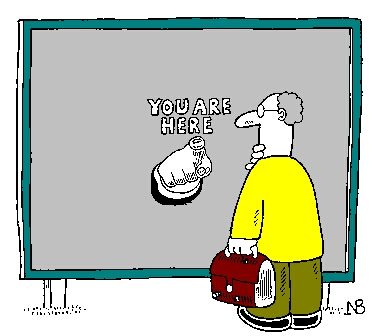
In the first post of this series I mentioned the psychological confusion generated by YAH ("you are here") maps.
I don't know about other mammals, but one big factor that throws people off in YAH scenarios is the "Y" ... the "you" ... the human.
We can never understand where WE are unless WE know what WE are.
Dredd Blog has been criticized ad nauseum over the years for explaining that so long as we don't know what a human is, we will continue to be disoriented in the context of YAH.
Today, I will use the space program that has been ongoing for years and years to illustrate the point.
We landed on the moon on this date almost 50 years ago (July 20, 1969).
Only a few years ago we discovered that only 1% of our genetic material is human, and the other 99% of our genetic material is microbial.
Not only that, we also learned that the microbial cells in and on us keep us healthy and/or alive (see video and this).
Anyway, the space program was designed without our knowing the "Y" of "YAH."
So, how are we going to exist in space without 99% of ourselves?
Is that why our bones turn rubbery in space after awhile?
What microbes do we have to take with us, including backup systems, when we travel in space?
You ask yourself some similar questions now ... but watch the video and especially the Q&A following the lecture to give yourself ideas.
Dr. Bassler, in the video below, (watch it to find out some critical YAH information) explains that we have only very recently found out that the "Y" is not what we have though it was for a few thousand years (On The New Meaning of "Human", 2).
Got "Y" ?
The next post in this series is here, the previous post in this series is here. Dr. Bonnie Bassler lecture, with a follow-up question answer session:
25:00 the language of bacteria has a basic word, with "carbons" (carbon atoms) added on to that basic molecule so as to make additional "words" used by different species of bacteria.
29:30 E. carotovora releases antibodies that it is immune to, so as to eradicate competition that are not immune to those antibodies.
39:00 many, if not all, bacteria use a word known by all bacteria, when communicating with other species of bacteria different from their own species.
57:25 Q&A session ... why did we just find this out 400 years after microbes were discovered using the first microscopes? "hubris ... snobbery ... dogma that only higher species have language, etc."
In November, 1956, Isaac Asimov published a short story entitled: "The Last Question" (HTML) (PDF).
On June 16, 1965 Bob Dylan recorded "Like A Rolling Stone" (video below) which was released in the album "Highway 61 Revisited," an album which also contained the song "Highway 61."
In 1934-1961 Arnold J. Toynbee wrote "A Study of History," which chronicled the dynamics of 19 "major" human civilizations through their "birth" and "death."
In January of 1845 Edgar Allan Poe published "The Raven," a narrative poem that touches upon the "birth" and "death" of the mysterious energy of romance, and some of its consequences.
All of those works, in one way or another, are concerned with the notion of entropy.
Entropy is a subject of physics as well as being a subject concerning the scope of the existence of human civilization, and even the scope of the existence of the current configuration of the universe itself.
In this post, today, I want to discuss some of the similarities in the concept of entropy, as they apply to our personal vision of ourselves, as well as some ways they apply to human civilization's vision of itself.
Since the title of today's post contains the word "BS," I will not neglect to include some of those notions along the way, so as to make an attempt to answer the question formed by the title.
It is About Dynamics of Energy
The concept of the laws of thermodynamics goes back in time to a point before the advent of quantum mechanics, so that particular "law" has had to have epigenetic evolutionary change over that span of time.
That includes Oil-Qaeda sponsored lies about no entropy, i.e. never running out of poison crude oil, even on our finite planet with finite resources (The Peak of The Oil Lies - 6).
Nevertheless, Oil-Qaeda will get to "Nevermore" one way or another.
Energy is Not Endless-Energy
Which leads to the notion of renewable, clean, and yes, endless energy (no entropy).
One of the laws of thermodynamics has to do with a perpetual motion machine, which is a myth and an illegality.
But with BS, perpetuity itself is also very difficult to grasp as a myth.
Unless one grasps that a perpetual motion machine is a mythical machine that creates new, previously non-existent energy in order to re-power itself.
Some scientists took a look at entropy and saw easily that poison crude oil was limited, i.e. while there is enough of it to kill us all, there is not enough to keep us going forever.
So they naturally looked elsewhere for perpetuity.
Such a grid or sphere is a system which is designed to harness the energy of the sun / star at the center of a solar system.
This is what "The Last Question" (by Asimov) details, in the sense that they tapped the solar energy of their sun.
To do so they used vast computer controlled systems placed in space:
"For decades, Multivac had helped design the ships and plot the trajectories that enabled man to reach the Moon, Mars, and Venus, but past that, Earth's poor resources could not support the ships. Too much energy was needed for the long trips. Earth exploited its coal and uranium with increasing efficiency, but there was only so much of both.
But slowly Multivac learned enough to answer deeper questions more fundamentally, and on May 14, 2061, what had been theory, became fact.
The energy of the sun was stored, converted, and utilized directly on a planet-wide scale. All Earth turned off its burning coal, its fissioning uranium, and flipped the switch that connected all of it to a small station, one mile in diameter, circling the Earth at half the distance of the Moon. All Earth ran by invisible beams of sunpower."
(ibid, link in first sentence of this post). I won't spoil it for you, so read it all, because it is quite interesting.
Entropy of Civilizations
This brings up the work of a once-very-popular historian, as I mentioned in the Introduction, who made this observation:
"In other words, a society does not ever die 'from natural causes', but always dies from suicide or murder --- and nearly always from the former, as this chapter has shown."
A type of decay which Freud attributed to group dynamics, and a psychology that was in need of a still non-existent therapy (Civilization Is Now On Suicide Watch).
Entropy of The Cosmos
There was once an accepted theory called the oscillating universe theory which is no longer favored, however, a hybrid version has now been advanced with a similar result in mind.
"The heat death of the universe is a historically suggested ultimate fate of the universe in which the universe has diminished to a state of no thermodynamic free energy and therefore can no longer sustain processes that consume energy (including computation and life). Heat death does not imply any particular absolute temperature; it only requires that temperature differences or other processes may no longer be exploited to perform work. In the language of physics, this is when the universe reaches thermodynamic equilibrium (maximum entropy)."
(Heat Death of the Universe, links & formatting removed). This is an old back and forth debate in science.
Therefore, it is subject to the laws of thermodynamics.
Nevertheless, some of us seem to be heading toward the Supreme BS Court in order to get the Cosmic Justices there to overturn the laws of thermodynamics.
The strategy is to thereby make everything immortal (like Oil-Qaeda did with oil through BS).
BTW, that is where everything ended up in the answer to "The Last Question" in Asimov's fiction (the same temperature).
As to Bob Dylan and Edgar Allan Poe, my take on their work, alluded to in the Introduction, is that "nevermore" and "like a rolling stone" are just artful ways of describing "entropy" (down hill until rolling nevermore).
As for BS, its users will have to pass The Test too.
Well then, since Californians, and others, think that California leads the nation, let's rub California's nose trance in it first: California Thinks It Leads The Nation.
My complaint, then, is that wrong leadership is worse than no leadership:
"Officials have implored Californians to cut down on water usage, but recent data show residents saved less water in February than in any other month since the state started tracking water conservation. Southern California residents actually used more water than average that month."
(California ... Worst Drought In 1,200 Years, emphasis added). The California reaction to a clear and present danger seems to be "keep on keeping on", "what, me worry?", "what water shortage?", "we never have bad weather like you do" - Bill Maher (paraphrased), and/or "who cares!"
So, the use of the word "pebble" to describe what a comet was made of caught my eye:
During its brief mission, Philae collected some key data, including images that show the entire comet may be made of pebbles, scientists said at the Lunar and Planetary Science Conference in Houston this week.
If confirmed, scientists will have to rethink how pebbles as big as some seen on 67P could form so far from the sun.
(Comet Made of Pebbles, emphasis added). My recollection of the meaning of "pebble" created images of the banks of beautiful streams and even some beaches.
So, I took another look at the definition of the word:
Definition of pebble in English:
noun
A small stone made smooth and round by the action of water or sand.
Example sentences:
We had sediments, river mud, pebbles rounded by water action, even the remains of aquatic plants on the site.
It's a lovely place and we walked across stepping stones and skimmed pebbles in the river.
They consist of particulate rocks that vary in size from sand to pebbles and cobbles.
(Oxford Dictionary, emphasis added, cf. pebble). This is the type of situation found repeatedly by our spacecraft.
Regular readers know that the Dredd Blog hypothesis, which is an extension of the EPH, is that one or more planets were destroyed and or damaged when the attempt to establish a Dyson Grid or Sphere failed:
Is the act of contemplating life on other planets in the universe a "scientific" thing to do?
At least in the sense of wondering how they might approach the issue of clean sources of energy compared with the other side of that coin, the many pollution generating sources of energy?
Or is such contemplation an activity properly left to mystics, UFO folk, and others of that "unscientific" ilk?
If scientists like Freeman Dyson professionally contemplate, and even go so far as to predict forms of alien energy systems, such as the "bubble" shown in the photo above, then the contemplation of extraterrestrial potential is by definition scientific ...
(Exploded Planet Hypothesis). We are constantly discovering new evidence of "bombardment" from asteroids and meteorites that have damaged all planets that we observe in our solar system.
Further, some of the planets (including Earth) may now be missing life forms which they once had (Nitrogen / Nitrates on Mars) before one or more planets were destroyed by explosions that sent damaging debris throughout the entire solar system (e.g. craters, asteroids, moons in retrograde orbits, reverse rotation of Venus, strata on asteroids, etc.).
Thus, we can remain scientific as we speculate about whether the comet with pebbles and sand all over it is a chunk of the remains of a river bed, or part of a pebble strewn beach.
Once part of an ancient planet that was somehow destroyed in an accident of monumental proportions.
From time to time our science becomes "rebellious."
Indicating its rebellion by saying: "Houston, we have a problem."
One could wonder why we never went back to the moon with younger Navy Seals, hovering over the moon dust while exclaiming "we have no stinking problems!"
We civilized people do not entertain the notion of "problems" on certain exceptional levels, especially those problems in the recipe that fate "manifest destiny" cooked up for us.
For your plebs and mine, in our world "final" means the one just before the next one.
Like da man said:
With doublespeak, banks don't have "bad loans" or "bad debts"; they have "nonperforming assets" or "nonperforming credits" which are "rolled over" or "rescheduled." Corporations never lose money; they just experience "negative cash flow," "deficit enhancement," "net profit revenue deficiencies," or "negative contributions to profits."
(Propaganda Is A "Toxic Asset", quoting professor Lutz). Which brings me to "The Innocence Project" ... as I understand it ... or as I don't understand it:
The Innocence Project is a non-profit legal organization that is committed to exonerating wrongly convicted people through the use of DNA testing, and to reforming the criminal justice system to prevent future injustice. The Innocence Project was founded in 1992 by Barry Scheck and Peter Neufeld. To date, the work of the Innocence Project has led to the freeing of 325 wrongfully convicted people, including 18 who spent time on death row.
(Boston Wikerpedier, emphasis added). The innocence, or lack thereof, of both individuals and groups, is a concept that floats atop a massive ocean of cognition.
That is the ocean in which we, using our cognition, decided to name "the evolution of justice."
An ocean traversed by the ship of state, a ship guided by the Department of Justice always, toward a broad and wide beach, a beach with a broad and wide port.
A port where many of its sailors have concluded "any port in a storm."
But those winds still blow incessantly:
From biology class to “C.S.I.,” we are told again and again that our genome is at the heart of our identity. Read the sequences in the chromosomes of a single cell, and learn everything about a person’s genetic information — or, as 23andme, a prominent genetic testing company, says on its Web site, “The more you know about your DNA, the more you know about yourself.”
But scientists are discovering that — to a surprising degree — we contain genetic multitudes. Not long ago, researchers had thought it was rare for the cells in a single healthy person to differ genetically in a significant way. But scientists are finding that it’s quite common for an individual to have multiple genomes. Some people, for example, have groups of cells with mutations that are not found in the rest of the body. Some have genomes that came from other people.
Medical researchers aren’t the only scientists interested in our multitudes of personal genomes. So are forensic scientists. When they attempt to identify criminals or murder victims by matching DNA, they want to avoid being misled by the variety of genomes inside a single person.
Last year, for example, forensic scientists at the Washington State Patrol Crime Laboratory Division described how a saliva sample and a sperm sample from the same suspect in a sexual assault case didn’t match.
(On The Origin of Genieology, emphasis added). Yikes! ... There are some other wild and crazy stories that should be told before the music plays.
Such as wondering about how many people have been wrongly convicted in our criminal justice system, because of wrongful DNA assumptions of a single genome in each individual.
However, since I feel so innocent today, let's musicate ...
A highway is located at the journey's destination, as well as being located at the journey's beginning (our criminal justice system is on the wrong highway).
"pearls and swine bereft of me
long and weary my road has been
i was lost in the cities alone in the hills
no sorrow or pity for leaving I feel"
...