Showing posts with label saturn. Show all posts

Friday, March 13, 2015

Weekend Rebel Science Excursion - 40

Enceladus is a moon of Saturn (click photo to enlarge)
I. Introduction

"TGIF" as they say, so let's talk some science.

I want to fuse the subject matter of several series with recent scientific developments.

A paper in the journal Nature has been talked about in the science press, a paper which presents evidence and argument that there is a hot ocean underneath the surface of a moon of Saturn, i.e., under the surface of Enceladus (Researchers Think There's A Warm Ocean On Enceladus).

I want to tie this in with the EPH (Exploded Planet Hypothesis, Weekend Rebel Science Excursion, Weekend Rebel Science Excursion - 11) and the nature of our civilization (Civilization Is Now On Suicide Watch), compared with the Tenets of Ecocosmology.

II. Civilizations in Space with Dyson Grids

Let's begin by considering a scale that describes hypothetical evolution of civilizations, in terms of a civilization's use of energy (Kardashev Scale).

Now, let's add to that the hypothesis of a civilization using a Dyson Grid or Sphere to harness solar energy in a way not commonly considered (Wikipedia: Dyson Sphere).

One Dredd Blog extension, or addition, to the EPH (The Challenge of the Exploded Planet Hypothesis, Cambridge Journals Online, International Journal of Astrobiology / Volume 6 / Issue 03 / July 2007, pp 185-197) is that there are remains of the structure of a Dyson Grid or Sphere still visible in our solar system (Saturn - Home of the Hexagon Mystery, Saturn Hexagon Mystifies Scientists).

Cosmologists and astronomers use the word "bombardment" to describe what made craters and did destruction on planets throughout our solar system  (e.g. early and late bombardment).

Note that "bombardment" and "exploded" go together.

III. What Could Go Wrong?

Civilizations on Earth have not been free from lethal mistakes, and in fact lethal mistakes are the rule rather than the exception according to a noted historian:
"In other words, a society does not ever die 'from natural causes', but always dies from suicide or murder --- and nearly always from the former, as this chapter has shown."
(A Study of History,  by Arnold J. Toynbee). So, let's consider a hypothetical mistake of an earlier civilization on a planet that exploded not too far from here, as a result of that lethal mistake.

I am talking about a planet between Mars and Jupiter, where only a debris field (a.k.a. asteroid belt) remains now.

It is a debris field being studied by the Dawn spacecraft even as we blog (Dawn Mission Nears Ceres Orbit Maneuvers).

So, to answer the question the title of this section asks, one thing that could go wrong is that a Dyson Grid or Sphere could malfunction.

Such a vast structure handles so much energy that a malfunction could be catastrophic.

Let's go figure.

IV. Some EPH Factors We Can Test

One of the expectations or assertions of the EPH is that Enceladus (like Vesta) is a chunk of the planet that exploded.

Enceladus, the hypothesis goes, contains among other things, some remnants and remains of that planet's ocean.

Outer layers of that water are now frozen over, except that, as mentioned above in the new paper (Nature: Ongoing hydrothermal activities within Enceladus), under the thick ice at the south pole is liquid ocean water, and some of it is hot.

How do we test that in terms of the EPH?

We can go back to the hypothesis of cosmologists that the planets and their moons are condensations of the dust cloud which eventually formed planets and the Sun (On the Origin of the Genes of Viruses - 8) "around 4.5 billion years ago".

We can also use what we know about Enceladus to calculate the amount of water there, and then calculate how long it would take to lose / eject that water into space.

V. Some Calculations

Let's begin with a statement from the paper published in Nature and linked to in section IV above:
"Gravitational field measurements suggest a regional south polar subsurface ocean of about 10 kilometres thickness located beneath an ice crust 30 to 40 kilometres thick."
(ibid, paper in journal Nature). It is interesting to note that the "regional south polar subsurface ocean" water is not uniform, in that, it is mostly at the south pole.

That indicates an abnormality which would be expected in the helter skelter debris of a planetary explosion.

Let's try to calculate the amount of water there, the amount that has been ejected, and how far backward and forward in time that ocean could hold water.
Fig. 1 (ocean water & ice cap @ South Pole)

The first thing we need to do is to calculate the volume of water in that south polar ocean, and in the ice cap.

Then we will calculate how long it would take for that water to be ejected into space to make Saturn’s E ring, to finally exhaust all water, and ultimately, how that comports with the theory of the formation of Enceladus some 4.5 billion years ago (or to the contrary to conform to when the planet exploded to eject its pieces into space).

Fig. 2 (concept of ice & water on Enceladus)
We will begin by calculating the volume of the ice layer.

This we do by calculating the whole volume of Enceladus, then calculating the volume of a sphere 40 km smaller (assume the ice layer is 40 km thick).

When subtracting the difference between the two, we derive the volume of the ice layer.

Hence: V = 4/3 π r3 [sphere volume]
V = 4/3 * 3.14 * 2523
V = 4/3 * 3.14 * 16003008
V = 1.33 * 50249445.12
V = 66,831,762 cu. km.
(now for the smaller sphere)
Fig. 3 (hot ocean water venting into space)
V = 4/3 π r3 [sphere volume]
V = 4/3 * 3.14 * 2123
V = 4/3 * 3.14 * 9528128
V = 1.33 * 29918321.92
V = 39,791,368 cu. km.

Now we can subtract the smaller sphere's volume from the larger sphere's volume to derive Enceladus' ice layer volume to be 27,040,394 cu. km. (66,831,762 cu. km. - 39,791,368 cu. km.).

To calculate the volume of water in the subsurface southern polar ocean, we use the following formula applied to the smaller sphere, to derive:
V = (π/3)H2(3R - H)  [cap of a sphere, Fig. 1]
V = (3.14/3)102(3*212 - 10)
V = (1.05)*100*(3*202)
V = (105)*(606)
V =  63,630 cu. km.

Now, we calculate the ejection of water into space which, among other things, forms Saturn’s E ring.

We can do this roughly by using a formula we have already used to calculate water hypothetically already vented from the asteroid Vesta in the debris field:
The violent ejections marked those strata with the "holes that were left as the water escaped" which after all these billions of years, still "stretch as much as 0.6 miles (1 kilometer) across and go down as deep as 700 feet (200 meters)."

For illustration only, the amount of water to fill just one of those cone shaped surface vents would be:
vent diameter = 1 kilometer (3280.8 ft)
radius (r) = 3280.8 / 2
r = ~1640 ft

height (h) = 700 feet

cone volume formula: v = 1/3 * 3.14 * r2 * h

v = .33 * 3.14 * 2,689,600 * 700

v = 1,950,874,464 ft3

assume there are 7.48 gallons of water per ft3

water in cone = 1,950,874,464 ft3 / 7.48 ft3

gallons of water = ~260,812,094 gal (for 1 vent)
I don't think meteorites would have the volume of water to cause such focused, and violent ejections to make cone-shaped vents a kilometer across and 700 feet deep, because among other things, the meteorite types with the most water are carbonaceous chondrite types, having 3% - 22% water by weight.
(Weekend Rebel Science Excursion - 11).  The use of the venting calculations in that post about Vesta helped to see that at least one venting hypothesis was unlikely in the case of Vesta (which is part of the debris field).

VI. Let's Vent

Figure 3 is an illustration of the venting taking place on Enceladus.

Six or seven vents are shown ejecting water from the subsurface southern ocean into
Fig. 4 Saturn's E-ring (click graphic to enlarge)
the space around Enceladus (which makes Saturn's E ring).

The 63,630 cu. km. in the subsurface ocean is 35,313,378,458 cu. ft. of water (63,630 * 3280.83 * 7.48), or 264,144,070,866 gallons (264,144,070,866 ÷ 260,812,094 [RE vent cone on Vesta] = 1012.8).

If the water began to vent a billion years ago, that equates to a loss of only 264 gallons a year, or only 132 gallons a year at 2 billion years ago (before the ocean is completely emptied into space).

Our solar system, and (supposedly) this moon are said to have formed some 4.5 billion years ago.

If the EPH planet exploded only 5 million years ago, that would mean a venting of  52,829 gallons a year, or if 2.5 million years ago, then 105,658 gallons a year.

All those numbers seem unlikely (way too small, see Fig. 4), so the outer ice layer must be melting into the ocean because of the heat, and replenishing the water (so as to allow venting of water for a much, much longer time).

In other words, the ice and water on Enceladus is evidently melting away, and will do so at least until the core heat goes away, or ultimately all the ice and water is gone.

This shows that Enceladus has not been there for 4.5 billion years, nor anything close to that (millions of years is more likely).

VII. Conclusion

An exploded planet about 1-3 million years ago, or maybe 65 mya @ KT-boundary Fifth Mass Extinction, or some other explanation, would seem to be more likely origins of Enceladus than any hypothetical origin 4.5 billion years ago.

One can only wonder how long it will take for Enceladus to look like Vesta.

Any suggestions or corrections?

Have a good weekend.

Wednesday, December 31, 2014

Looking Back on 2014: Posts I Could Not Complete

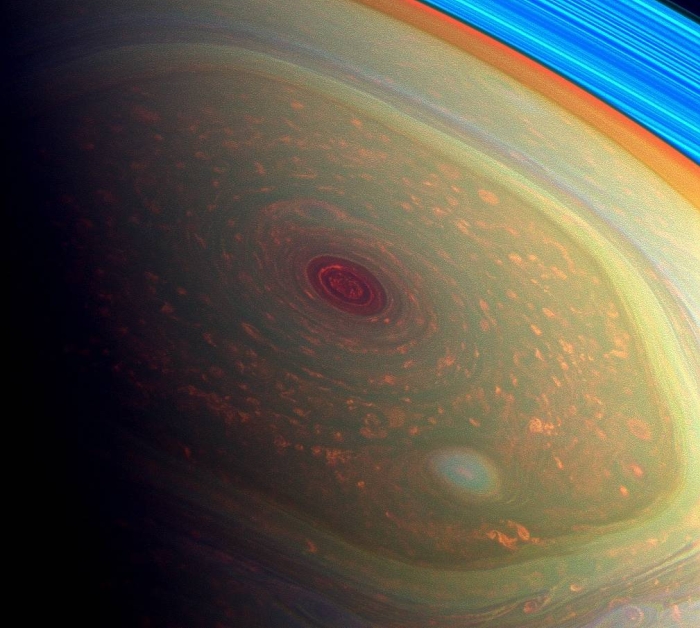
Hexagon: Inverse of NASA colors (see last image)
There were quite a few posts I wanted to get to but had "writer's block" or blogger's block, and just could not "git 'R dun" for some reason.

So, in surrender, and to get beyond the block, I am providing the names of the posts that were not written, but not the links that were to have been included in those embryonic posts that were never born.

The three graphics shown in today's post are NASA Cassini-Huygens photos of the mysterious hexagon on the planet Saturn's north pole.

I have managed to write about it a time or two in times past (Saturn's Many Mysteries, Saturn - Home of the Hexagon Mystery, cf. Exploded Planet Hypothesis).
Hexagon & 'hot-spot' outlined
Original NASA Colors

There are many things about our planet, our Sun, our solar system, ourselves, and our universe that we do not understand.

So, it is fun sometimes to speculate and indulge in some science fiction mixed as always with scientific facts.

The year that begins tomorrow will be another interesting year.

I wrote about one event that will put climate change in the forefront of some minds that have not yet contemplated it fully (Message of Science & Religion - Western - 2).

There are many other events, such as the rising danger of nuclear war, as well as the rising sea levels, that will keep The Dredd Blog System focused on important issues.

Another mystery that was not solved in 2014 is the book written in a language that has not been deciphered yet.

I wrote about it some years ago (Ancient Ecocosmology?).

Anyway, here are the unfinished (shame on me) posts I planned to do, but failed to write, during 2014 --but which I plan to try again to complete in 2015:
Exploded Planet Hypothesis - 3
Ecosystems, Microbes, Viruses, and Virulence
Earth Farming vs. Organic Farming
A Savvy Ecocosmological Earth Calendar - 3
Big Bang Challenges
Wanted: Technology To Save Our Species - 2 (Done)
What Kind of Intelligence is Prescience? - 3
The Little People - 3
A Religious Doctrine For Toxins of Power - 2
Is Specialization a Source of Toxins of Power?
On The Origin of the Toxins of Conspiracy Power
Toxoplasmosis - Sapolsky
Origin of Cats
The Pillars of Knowledge: Faith and Trust? - 2
Propaganda In Microbes

Thanks to all readers from all over the world who read Dredd Blog System posts (Who Reads Dredd Blog).

Wednesday, August 13, 2014

The Last Known Photo of Robin "Mork" Williams Heading Home

Mork returning to Ork
On this date in 2009 we considered one of our "ringed planets."

Saturn is the most famous of the ringed planets, garnering that "fame" before we discovered that other planets in our solar system also have rings.

The photo to the left (click to enlarge) is of "an object" traversing the F ring of Saturn, which made me think of Robin Williams and his character Mork of the Mork & Mindy Show.

Mork probably dropped a few F bombs while going through the F ring on his way back to Ork (perhaps because of what Earth Civilization seemed like to him).

Anyway, here is the post from that date:

One Mystery After Another At Saturn

The school bus sized Cassini spacecraft has photographed another strange phenomenon.

An object was photographed travelling through the "F" ring of the planet Saturn. Is it a small satellite in a strange orbit, a stray asteroid, or the Enterprise going through a time warp heading back to Earth?

As you can see, the object made the ring very bright behind it, and cast a shadow on rings closer to the camera.

It seems that constantly there are new discoveries around Saturn, from satellites orbiting "the wrong way" (e.g. Norse Group), to the great hexagon, to Enceladus, which is building rings around the planet with water from its own geysers.


Thursday, September 20, 2012

The Mystery of Science Friction

Where are the microbes?
What is science friction?

We sometimes tend to forget how much scientists challenge one another, even causing friction from time to time, and we tend to forget how much that can help move science along.

In a more severe sense today's "science" even sometimes becomes tomorrow's "heresy" (see e.g. What Is Pseudo Science?, Heretics Deny The Dark Matter of Faith, Tyranny Of Dogma In Science, and State Crimes Against Democracy).

Yes, the status quo sometimes has more gravity and mass than "new stuff", more gravity and mass than the status quo should have, and hence the friction.

A recent example concerns the Earth - Mars interactions that occur in the form of Martian meteorites making their way to the Earth's surface.

Naturally the scientists want to examine those meteorites to determine what they are made of, but some of the scientists have taken a look inside for evidence of life, and have come up with friction generating results:
Richard Hoover has discovered evidence of microfossils similar to Cyanobacteria, in freshly fractured slices of the interior surfaces of the Alais, Ivuna, and Orgueil CI1 carbonaceous meteorites. Based on Field Emission Scanning Electron Microscopy (FESEM) and other measures, Richard Hoover has concluded they are indigenous to these meteors and are similar to trichomic cyanobacteria and other trichomic prokaryotes such as filamentous sulfur bacteria. He concludes these fossilized bacteria are not Earthly contaminants but are the fossilized remains of living organisms which lived in the parent bodies of these meteors, e.g. comets, moons, and other astral bodies.
(A Structure RE: The Corruption of Memes). Another discovery presents an interesting nexus between microbial life of that sort and things found on both Earth and Mars, which were nicknamed "blueberries" by scientists:
It was originally thought that those spheres of hematite here on Earth, and by extrapolation those on Mars, were chemically produced, not organically produced.

However, and to the contrary, new research of similar hematite spheres here on Earth has found that those here on Earth were formed by microbes:
Spherical iron-oxide concretions - dubbed "blueberries" - were first found on the Red Planet in 2004 by an earlier NASA robotic probe - Opportunity Rover - providing some of the first evidence for liquid water on Mars.

Earth-based analogues for these "blueberries" are found in the Jurassic Navajo Sandstone near the Colorado River, Utah, where the concretions range in size from small marbles to cannonballs and consist of a hard shell of iron oxide surrounding a softer sandy interior.

Previous theories suggested these concretions were formed by simple chemical reactions without the help of life. However, new UWA research shows clear evidence that microbes were essential in their formation.

This raises the possibility that Martian "blueberries" may not only reveal that water was present on Mars - but life too.
(Phys Org). This may also hold true for the new type of "blueberries" found in Endeavour Crater very recently, found also by the Opportunity Rover:
NASA's long-lived rover Opportunity has returned an image of the Martian surface that is puzzling researchers.

Spherical objects concentrated at an outcrop called Kirkwood on the western rim of Endeavour Crater differ in several ways from iron-rich spherules nicknamed "blueberries" the rover found at its landing site in early 2004.

"This is one of the most extraordinary pictures from the whole mission," said Opportunity's principal investigator, Steve Squyres of Cornell University in Ithaca, N.Y. "Kirkwood is chock full of a dense accumulation of these small spherical objects. Of course, we immediately thought of the blueberries, but this is something different. We never have seen such a dense accumulation of spherules in a rock outcrop on Mars."
(Mystery Spheres on Mars, NASA). The spherical objects at Endeavour are not of the same composition as those found in 2004 shortly after Opportunity landed.
(Cosmic Rosetta Stones?). So, we know that the spherical stones called "blueberries" were made by microbial activity here on Earth, not by purely chemical process as was once thought.

So, the possibility that their twins on Mars were likewise made by microbes is a plausible reality, especially since microbe fossils from ancient Mars have been found in meteorites here on Earth.

The theory that a planet near Mars exploded long ago, destroying the ecosystems of Mars (Weekend Rebel Science Excursion), together with the theory that a Dyson Grid malfunctioned to cause that explosion, creates yet more science friction (Exploded Planet Hypothesis).

The new Mars Rover Curiosity (Mars: Analyzing Layers of History) will hopefully take some of the friction out of the discussion, and add some more settled science to the discussion.

Isn't science friction fun?

Wednesday, March 9, 2011

Cassini Finds Enceladus is a Powerhouse

PASADENA, Calif. -- Heat output from the south polar region of Saturn's moon Enceladus is much greater than was previously thought possible, according to a new analysis of data collected by NASA's Cassini spacecraft. The study was published in the Journal of Geophysical Research on March 4.

Data from Cassini's composite infrared spectrometer of Enceladus' south polar terrain, which is marked by linear fissures, indicate that the internal heat-generated power is about 15.8 gigawatts, approximately 2.6 times the power output of all the hot springs in the Yellowstone region, or comparable to 20 coal-fueled power stations. This is more than an order of magnitude higher than scientists had predicted, according to Carly Howett, the lead author of study, who is a postdoctoral researcher at Southwest Research Institute in Boulder, Colo., and a composite infrared spectrometer science team member.

"The mechanism capable of producing the much higher observed internal power remains a mystery and challenges the currently proposed models of long-term heat production," said Howett.

It has been known since 2005 that Enceladus' south polar terrain is geologically active and the activity is centered on four roughly parallel linear trenches, 130 kilometers (80 miles) long and about 2 kilometers (1 mile) wide, informally known as the "tiger stripes." Cassini also found that these fissures eject great plumes of ice particles and water vapor continually into space. These trenches have elevated temperatures due to heat leaking out of Enceladus' interior.

A 2007 study predicted the internal heat of Enceladus, if principally generated by tidal forces arising from the orbital resonance between Enceladus and another moon, Dione, could be no greater than 1.1 gigawatts averaged over the long term. Heating from natural radioactivity inside Enceladus would add another 0.3 gigawatts.

The latest analysis, which also involved the composite infrared spectrometer team members John Spencer at Southwest Research Institute, and John Pearl and Marcia Segura at NASA's Goddard Space Flight Center in Greenbelt, Md., uses observations taken in 2008, which cover the entire south polar terrain. They constrained Enceladus' surface temperatures to determine the region's surprisingly high output.

A possible explanation of the high heat flow observed is that Enceladus' orbital relationship to Saturn and Dione changes with time, allowing periods of more intensive tidal heating, separated by more quiescent periods. This means Cassini might be lucky enough to be seeing Enceladus when it's unusually active.

The new, higher heat flow determination makes it even more likely that liquid water exists below Enceladus' surface, Howett noted.

Recently, scientists studying ice particles ejected from the plumes discovered that some of the particles are salt-rich, and are probably frozen droplets from a saltwater ocean in contact with Enceladus' mineral-rich rocky core. The presence of a subsurface ocean, or perhaps a south polar sea between the moon's outer ice shell and its rocky interior would increase the efficiency of the tidal heating by allowing greater tidal distortions of the ice shell.

"The possibility of liquid water, a tidal energy source and the observation of organic (carbon-rich) chemicals in the plume of Enceladus make the satellite a site of strong astrobiological interest," Howett said.

The Cassini-Huygens mission is a cooperative project of NASA, the European Space Agency and the Italian Space Agency. NASA's Jet Propulsion Laboratory, Pasadena, Calif., a division of the California Institute of Technology in Pasadena, manages the mission for NASA's Science Mission Directorate, Washington, D.C. The Cassini orbiter was designed, developed and assembled at JPL. The CIRS team is based at NASA's Goddard Space Flight Center in Greenbelt, Md., where the instrument was built.

More information

Thursday, August 13, 2009

One Mystery After Another At Saturn

The school bus sized Cassini spacecraft has photographed another strange phenomenon.

An object was photographed travelling through the "F" ring of the planet Saturn. Is it a small satellite in a strange orbit, a stray asteroid, or the Enterprise going through a time warp heading back to Earth?

As you can see, the object made the ring very bright behind it, and cast a shadow on rings closer to the camera.

It seems that there are constantly new discoveries around Saturn, from satellites orbiting "the wrong way" (e.g. Norse Group), to the great hexagon, to Enceladus, which is building rings around the planet with water from its own geysers.

Sunday, July 26, 2009

Weekend Rebel Science Excursion - 2

"Rebel science" is fun on weekends, because it drives the MSM all mavericky, causes them to yell "conspiracy theory" into their microphones, and then break for commercials.

This blog has entertained the rebellion in prior posts, because the data support multiple theories, not just the ones pumped out by Big Brother.

So, on with the show.

NASA is now sure that its Cassini spacecraft, which has been exploring Saturn, its rings, and its moons, has discovered ammonia on Enceladus.

"Whoopie fraggin doo" you say, "I have ammonia in my bathroom closet". The big thing about this, gang, is that they have also found organics in the water and in the outer ring of Saturn which Enceladus is building and has been building.

Several things come up. One, as you know I subscribe to the exploded planet hypothesis for explaining the debris field (asteroid belt) between Mars & Jupiter. I also consider some of the moons of Saturn, specifically Enceladus, to be parts of the ocean on that planet that exploded.

When the planet exploded some of its ocean, the sandy bed under that ocean, and some bedrock under that were cast into space and were then captured by Jupiter and Saturn's gravity. Any life in that ocean probably died, except perhaps some microbes.

Any chunk like that cast into space which is over 400 miles in diameter will form a globe shape due to the power of its own gravity. The rocky material will settle toward the center. This is exactly the way several moons of Jupiter and Saturn are composed and structured; lots of water, organics, and harder inner cores.

There is another thing, since Enceladus is finite and has only a certain amount of water, and it is responsible for building the outer ring of Saturn with that water, it had to have come to Saturn relatively recently. By "relatively recently" I speak in terms of multiple millions of years, because Saturn is about 4 billion years old.

Enceladus would have already run out of water to build the outer ring if it came into existence when Saturn did some 4 billion years ago. The water would have run out in a comparatively short time, since Enceladus is only about 500 miles in diameter.

Thus, Saturn offers so many mysteries that the science textbooks are shaking in their boots.

More discoveries in China are likewise sure to have more textbooks thinking about the great shredder in the sky.

The next post in this series is here, the previous post in this series is here.

Sunday, January 11, 2009

Saturn's Many Mysteries

The Cassini spacecraft has found many wonders on and around the planet Saturn. Especially at the north pole.

One of the more perplexing and exciting discoveries was the hexagon and the scientifically unexpected aurora over it (Saturn's Poles). And that was found after a hot spot was unexpectedly found in the center of the totally unexpected hexagon.

It was first discovered two decades ago by an early mission to Saturn. It was seen again in the 1990's and now Cassini has photographed it up close and personal.

As it is studied more and more questions tend to arise. How does a hexagon shape get formed? And how does it then remain over the years in 300 mph hurricane and tornado force winds? Especially in Saturn's heavy atmosphere?

It is quite unlike the more famous Giant Red Spot on Jupiter, which is a hurricane shaped and more circular object as one would expect.

It shows once again, as we throw out the textbooks and print new ones, that our knowledge of the solar system and the universe is limited (Discovery Channel Article [it got lost, so Wayback Machine Version]).