Showing posts with label cassini. Show all posts

Wednesday, December 31, 2014

Looking Back on 2014: Posts I Could Not Complete

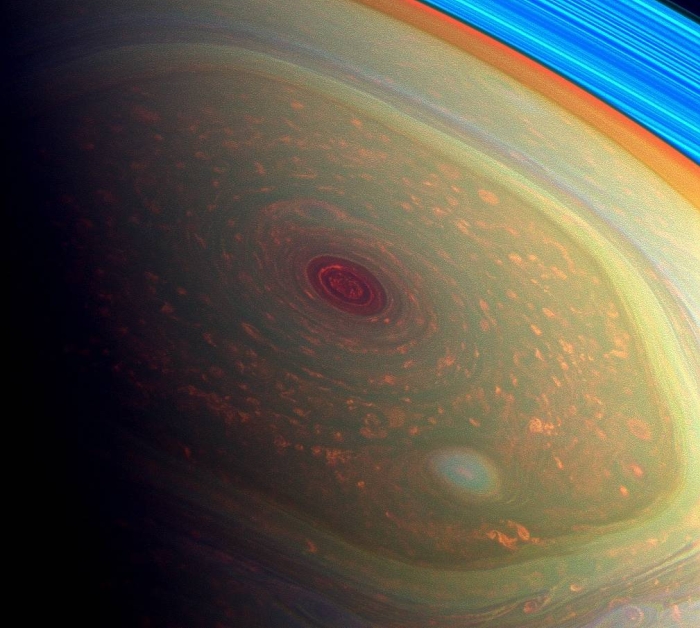
Hexagon: Inverse of NASA colors (see last image)
There were quite a few posts I wanted to get to but had "writer's block" or blogger's block, and just could not "git 'R dun" for some reason.

So, in surrender, and to get beyond the block, I am providing the names of the posts that were not written, but not the links that were to have been included in those embryonic posts that were never born.

The three graphics shown in today's post are NASA Cassini-Huygens photos of the mysterious hexagon on the planet Saturn's north pole.

I have managed to write about it a time or two in times past (Saturn's Many Mysteries, Saturn - Home of the Hexagon Mystery, cf. Exploded Planet Hypothesis).
Hexagon & 'hot-spot' outlined
Original NASA Colors

There are many things about our planet, our Sun, our solar system, ourselves, and our universe that we do not understand.

So, it is fun sometimes to speculate and indulge in some science fiction mixed as always with scientific facts.

The year that begins tomorrow will be another interesting year.

I wrote about one event that will put climate change in the forefront of some minds that have not yet contemplated it fully (Message of Science & Religion - Western - 2).

There are many other events, such as the rising danger of nuclear war, as well as the rising sea levels, that will keep The Dredd Blog System focused on important issues.

Another mystery that was not solved in 2014 is the book written in a language that has not been deciphered yet.

I wrote about it some years ago (Ancient Ecocosmology?).

Anyway, here are the unfinished (shame on me) posts I planned to do, but failed to write, during 2014 --but which I plan to try again to complete in 2015:
Exploded Planet Hypothesis - 3
Ecosystems, Microbes, Viruses, and Virulence
Earth Farming vs. Organic Farming
A Savvy Ecocosmological Earth Calendar - 3
Big Bang Challenges
Wanted: Technology To Save Our Species - 2 (Done)
What Kind of Intelligence is Prescience? - 3
The Little People - 3
A Religious Doctrine For Toxins of Power - 2
Is Specialization a Source of Toxins of Power?
On The Origin of the Toxins of Conspiracy Power
Toxoplasmosis - Sapolsky
Origin of Cats
The Pillars of Knowledge: Faith and Trust? - 2
Propaganda In Microbes

Thanks to all readers from all over the world who read Dredd Blog System posts (Who Reads Dredd Blog).

Wednesday, March 9, 2011

Cassini Finds Enceladus is a Powerhouse

PASADENA, Calif. -- Heat output from the south polar region of Saturn's moon Enceladus is much greater than was previously thought possible, according to a new analysis of data collected by NASA's Cassini spacecraft. The study was published in the Journal of Geophysical Research on March 4.

Data from Cassini's composite infrared spectrometer of Enceladus' south polar terrain, which is marked by linear fissures, indicate that the internal heat-generated power is about 15.8 gigawatts, approximately 2.6 times the power output of all the hot springs in the Yellowstone region, or comparable to 20 coal-fueled power stations. This is more than an order of magnitude higher than scientists had predicted, according to Carly Howett, the lead author of study, who is a postdoctoral researcher at Southwest Research Institute in Boulder, Colo., and a composite infrared spectrometer science team member.

"The mechanism capable of producing the much higher observed internal power remains a mystery and challenges the currently proposed models of long-term heat production," said Howett.

It has been known since 2005 that Enceladus' south polar terrain is geologically active and the activity is centered on four roughly parallel linear trenches, 130 kilometers (80 miles) long and about 2 kilometers (1 mile) wide, informally known as the "tiger stripes." Cassini also found that these fissures eject great plumes of ice particles and water vapor continually into space. These trenches have elevated temperatures due to heat leaking out of Enceladus' interior.

A 2007 study predicted the internal heat of Enceladus, if principally generated by tidal forces arising from the orbital resonance between Enceladus and another moon, Dione, could be no greater than 1.1 gigawatts averaged over the long term. Heating from natural radioactivity inside Enceladus would add another 0.3 gigawatts.

The latest analysis, which also involved the composite infrared spectrometer team members John Spencer at Southwest Research Institute, and John Pearl and Marcia Segura at NASA's Goddard Space Flight Center in Greenbelt, Md., uses observations taken in 2008, which cover the entire south polar terrain. They constrained Enceladus' surface temperatures to determine the region's surprisingly high output.

A possible explanation of the high heat flow observed is that Enceladus' orbital relationship to Saturn and Dione changes with time, allowing periods of more intensive tidal heating, separated by more quiescent periods. This means Cassini might be lucky enough to be seeing Enceladus when it's unusually active.

The new, higher heat flow determination makes it even more likely that liquid water exists below Enceladus' surface, Howett noted.

Recently, scientists studying ice particles ejected from the plumes discovered that some of the particles are salt-rich, and are probably frozen droplets from a saltwater ocean in contact with Enceladus' mineral-rich rocky core. The presence of a subsurface ocean, or perhaps a south polar sea between the moon's outer ice shell and its rocky interior would increase the efficiency of the tidal heating by allowing greater tidal distortions of the ice shell.

"The possibility of liquid water, a tidal energy source and the observation of organic (carbon-rich) chemicals in the plume of Enceladus make the satellite a site of strong astrobiological interest," Howett said.

The Cassini-Huygens mission is a cooperative project of NASA, the European Space Agency and the Italian Space Agency. NASA's Jet Propulsion Laboratory, Pasadena, Calif., a division of the California Institute of Technology in Pasadena, manages the mission for NASA's Science Mission Directorate, Washington, D.C. The Cassini orbiter was designed, developed and assembled at JPL. The CIRS team is based at NASA's Goddard Space Flight Center in Greenbelt, Md., where the instrument was built.

More information

Thursday, August 13, 2009

One Mystery After Another At Saturn

The school bus sized Cassini spacecraft has photographed another strange phenomenon.

An object was photographed travelling through the "F" ring of the planet Saturn. Is it a small satellite in a strange orbit, a stray asteroid, or the Enterprise going through a time warp heading back to Earth?

As you can see, the object made the ring very bright behind it, and cast a shadow on rings closer to the camera.

It seems that there are constantly new discoveries around Saturn, from satellites orbiting "the wrong way" (e.g. Norse Group), to the great hexagon, to Enceladus, which is building rings around the planet with water from its own geysers.

Thursday, March 12, 2009

Start Your Backup Thrusters

The current NASA mission to the planet Saturn is named Cassini-Huygens.

The project is already an overwhelming success, and has successfully adjusted to a backup thruster system early this morning.

We have written about some of the wonderful and inexplicable discoveries the Cassini mission has accomplished.

The only downside is that many science textbooks have had to be thrown away.

Sunday, January 11, 2009

Saturn's Many Mysteries

The Cassini spacecraft has found many wonders on and around the planet Saturn. Especially at the north pole.

One of the more perplexing and exciting discoveries was the hexagon and the scientifically unexpected aurora over it (Saturn's Poles). And that was found after a hot spot was unexpectedly found in the center of the totally unexpected hexagon.

It was first discovered two decades ago by an early mission to Saturn. It was seen again in the 1990's and now Cassini has photographed it up close and personal.

As it is studied more and more questions tend to arise. How does a hexagon shape get formed? And how does it then remain over the years in 300 mph hurricane and tornado force winds? Especially in Saturn's heavy atmosphere?

It is quite unlike the more famous Giant Red Spot on Jupiter, which is a hurricane shaped and more circular object as one would expect.

It shows once again, as we throw out the textbooks and print new ones, that our knowledge of the solar system and the universe is limited (Discovery Channel Article [it got lost, so Wayback Machine Version]).